
Content
A hex head bolt is the most universally used threaded fastener, defined by its six-sided head, full or partial thread shank, and requirement for a separate washer to distribute clamping load. A hex flange bolt is a direct evolution of the same fastener — it incorporates a wide, circular flange integrated beneath the hex head that acts as a built-in washer, distributing load over a larger bearing area without requiring a separate component. Choose a standard hex head bolt for general structural, civil, and heavy industrial applications where washers are standard practice; choose a hex flange bolt where assembly speed, reduced part count, or thin/soft substrate load distribution is a priority — particularly in automotive, HVAC, and light manufacturing assemblies.
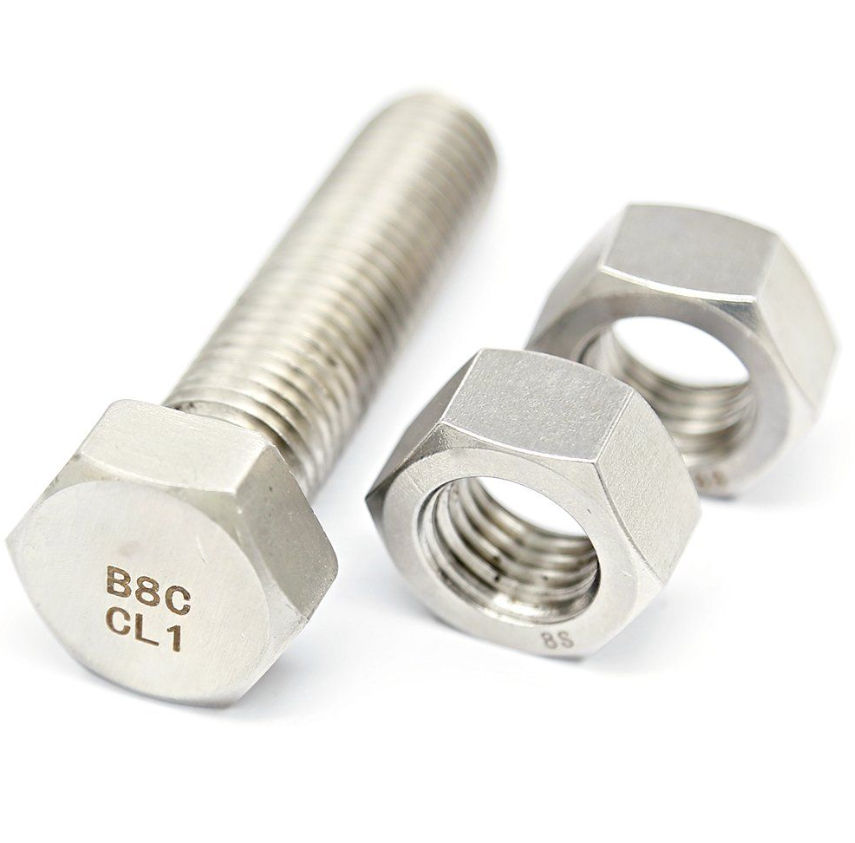
The hex head bolt — sometimes called a hex cap screw when it features a closer dimensional tolerance and a washer face under the head — is defined by its hexagonal head profile, which allows engagement by standard open-end, box-end, socket, and adjustable wrenches. The head's six flat faces and defined width-across-flats (WAF) dimension are the basis of wrench sizing across all metric and imperial fastener standards.
Hex head bolts are manufactured to tightly controlled dimensional standards that define head height, width across flats, width across corners, thread engagement length, and shank tolerances. The primary standards in global use are:
| Thread Size | Width Across Flats (mm) | Head Height (mm) | Thread Pitch (mm) | Wrench Size |
|---|---|---|---|---|
| M6 | 10 | 4.0 | 1.0 | 10 mm |
| M8 | 13 | 5.3 | 1.25 | 13 mm |
| M10 | 17 | 6.4 | 1.5 | 17 mm |
| M12 | 19 | 7.5 | 1.75 | 19 mm |
| M16 | 24 | 10.0 | 2.0 | 24 mm |
| M20 | 30 | 12.5 | 2.5 | 30 mm |
| M24 | 36 | 15.0 | 3.0 | 36 mm |
The choice between partially and fully threaded hex bolts is functionally significant and not merely a production variation. A partially threaded bolt (ISO 4014 / DIN 931) has an unthreaded shank section between the head and the threaded portion. This unthreaded shank acts as a precision dowel in the bolt hole, resisting shear forces across the joint interface without placing shear stress on the thread form — which is a stress concentration point. Structural bolt standards such as AISC and EN 1090 specifically require that threads do not occupy the shear plane in slip-critical connections for this reason. A fully threaded bolt (ISO 4017 / DIN 933) has threads running the full length to the underside of the head. This maximizes thread engagement length for tensile loading but means threads may cross the shear plane in some joint geometries, which is acceptable for non-slip-critical connections.
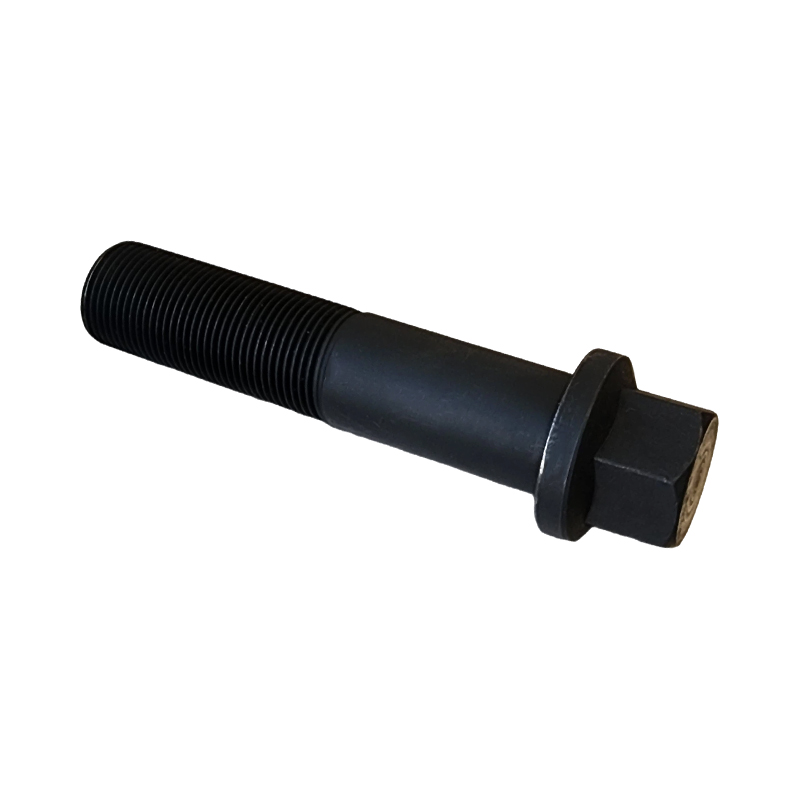
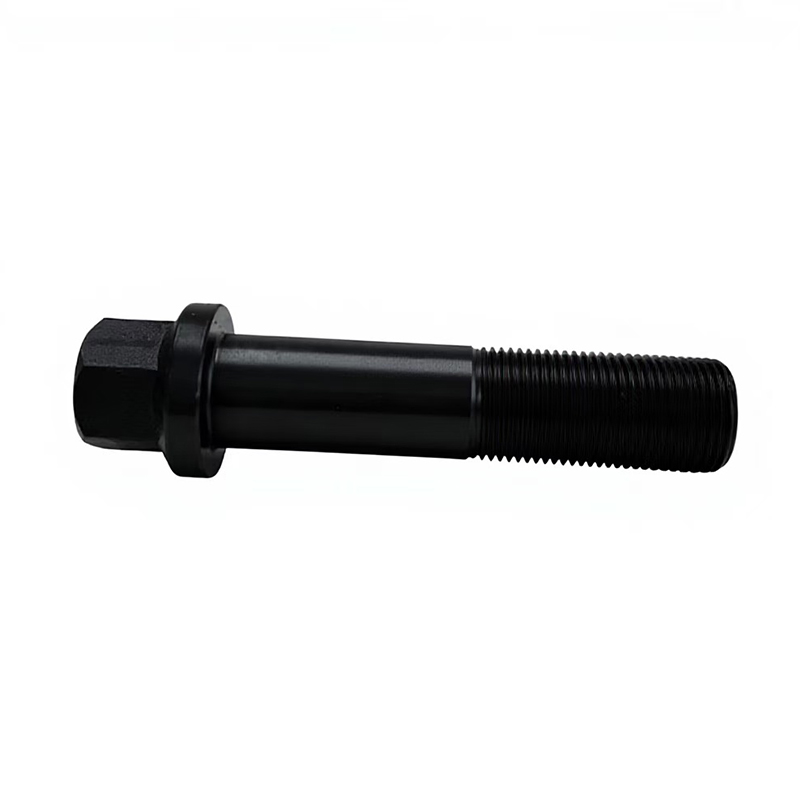
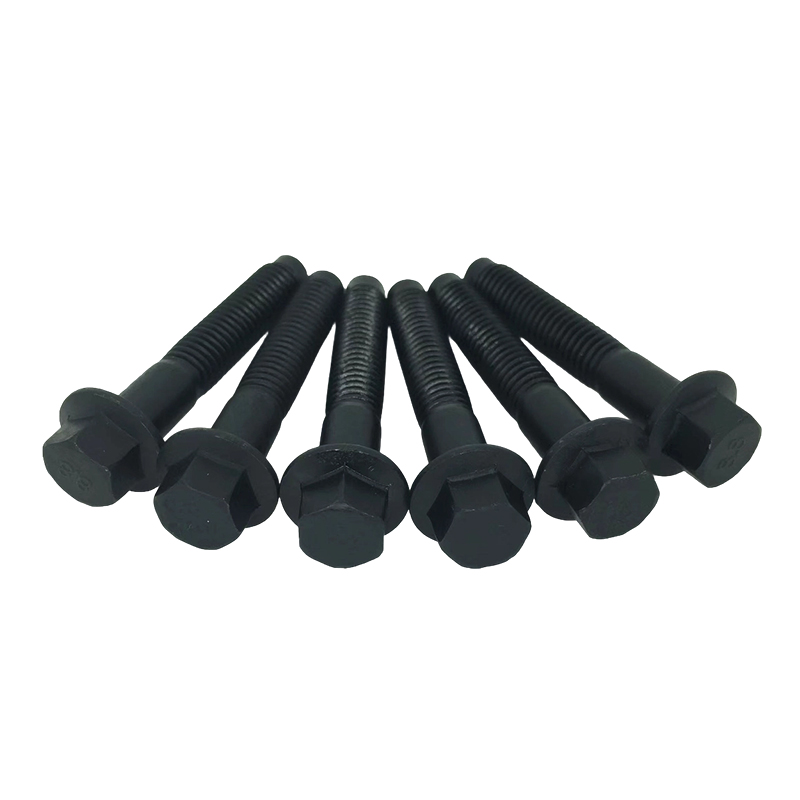
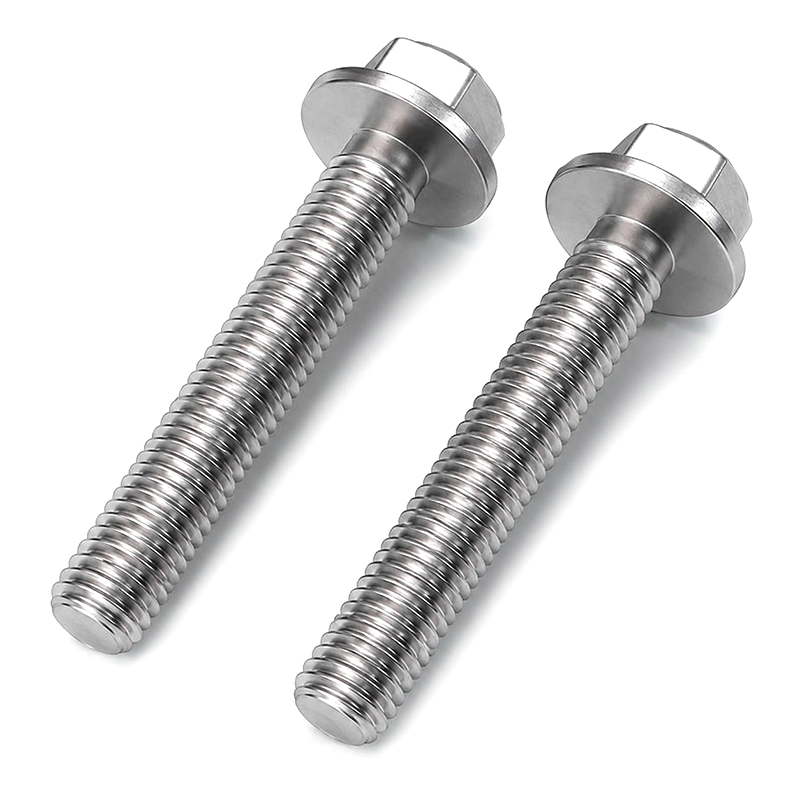
The hex flange bolt — standardized under ISO 15071 (metric, non-serrated) and DIN 6921 (with serrations) — adds a circular, washer-like flange to the underside of a standard hex head. The flange is forged or cold-formed as an integral part of the bolt head, not a separate component. This single design change produces a substantially different fastener behavior in several key areas.
The flange increases the bearing area under the bolt head — the surface area over which clamping force is distributed into the joint material. For an M10 hex bolt without a washer, the bearing area under the head is approximately 78 mm². An M10 hex flange bolt with a flange diameter of approximately 21–22 mm increases this to approximately 260–290 mm² — more than triple the bearing area. This matters significantly in applications involving:
This is the most important sub-distinction within the hex flange bolt category:
| Thread Size | Hex WAF (mm) | Flange Diameter (mm) | Flange Thickness (mm) | Head Height (mm) |
|---|---|---|---|---|
| M6 | 10 | 14.2 | 1.1 | 5.7 |
| M8 | 13 | 17.9 | 1.4 | 7.6 |
| M10 | 15 or 16 | 21.8 | 1.8 | 9.6 |
| M12 | 18 | 26.0 | 2.0 | 11.4 |
| M14 | 21 | 29.9 | 2.3 | 13.2 |
| M16 | 24 | 34.5 | 2.6 | 15.6 |
Note that the hex WAF on flange bolts is often one size smaller than on a standard hex bolt of the same thread diameter (e.g., M10 flange bolt uses a 15 or 16 mm wrench rather than the 17 mm required for a standard ISO 4014 M10 bolt). This is because the flange itself provides rotational grip surface during installation, and the reduced hex WAF saves material and reduces overall head envelope size — an advantage in confined assembly spaces.
Understanding the structural and practical differences between these two bolt types is essential for making the correct fastener selection. The following comparison covers the dimensions and functional factors that matter most in engineering and manufacturing decisions.
| Characteristic | Hex Head Bolt | Hex Flange Bolt |
|---|---|---|
| Head Bearing Area (M10) | ~78 mm² (without washer) | ~260–290 mm² (integral flange) |
| Washer Required | Usually yes (for load distribution) | No (flange acts as washer) |
| Vibration Resistance | Moderate (requires lock washer or Nordlock for high vibration) | High (serrated version provides integral locking) |
| Assembly Speed | Slower (washer handling required) | Faster (single component) |
| Part Count Per Joint | 3 (bolt + washer + nut) or 2 (bolt + nut into tapped hole) | 2 (bolt + nut) or 1 (into tapped hole) |
| Torque Consistency | Variable if washer is not consistent in hardness/surface | More consistent (integral flange, defined contact geometry) |
| Suitability for Thin Sheet | Poor without washer; good with large washer | Good (flange distributes load over larger area) |
| Structural / Civil Engineering Use | Standard — covered by EN 15048, ASTM F3125 | Not typical — flange bolts not covered by structural bolt standards |
| Primary Industries | Construction, oil and gas, machinery, infrastructure | Automotive, HVAC, appliances, light manufacturing |
| Cost per Unit | Lower (simpler geometry) | Slightly higher (more complex forging) |
Both hex head bolts and hex flange bolts are available across a range of mechanical property classes that define their tensile strength, yield strength, and proof load. Selecting the wrong property class is a common engineering error that leads to either premature joint failure (under-specified) or unnecessary cost and weight (over-specified).
Metric bolts are classified under ISO 898-1, with the property class marked on the bolt head as two numbers separated by a decimal point. The first number indicates 1/100th of the nominal tensile strength in MPa; the second indicates the ratio of yield to tensile strength multiplied by 10.
| Property Class | Nominal Tensile Strength (MPa) | Yield Strength (MPa) | Typical Application |
|---|---|---|---|
| 4.6 | 400 | 240 | Light-duty, non-critical joints |
| 5.6 | 500 | 300 | General engineering |
| 8.8 | 800 | 640 | Most common structural and mechanical grade |
| 10.9 | 1000 | 900 | High-strength structural, automotive powertrain |
| 12.9 | 1200 | 1080 | Critical high-load applications, motorsport, aerospace |
Class 8.8 is the most widely used property class for both hex head and hex flange bolts in mechanical and light structural applications. It provides a well-balanced combination of strength, ductility, and cost — manufactured from medium carbon steel with quenching and tempering. Class 10.9 flange bolts are common in automotive engine and drivetrain assemblies where high clamping force in compact joint geometries is required.
Inch-series hex bolts use SAE grade markings — radial lines on the bolt head — rather than numbers. The most common grades are SAE Grade 2 (no marks, low-carbon steel, 74,000 psi tensile), SAE Grade 5 (3 radial lines, 120,000 psi tensile — the most common structural grade), and SAE Grade 8 (6 radial lines, 150,000 psi tensile — high-strength for demanding applications). ASTM designations (A307, A325, A490) are used for structural bolts in building and bridge construction, with A325 (equivalent to approximately Grade 5 in strength) being the standard structural bolt in North American steel construction.
Both hex head and hex flange bolts are available in a range of materials and surface treatments. The correct specification depends on the operating environment, required strength, weight constraints, and corrosion exposure.
The overwhelming majority of hex bolts and flange bolts in industrial use are manufactured from low, medium, or alloy carbon steel, heat-treated to the required property class. Carbon steel bolts offer the best combination of tensile strength, machinability, and cost. Their primary limitation is susceptibility to corrosion in humid, outdoor, or chemical environments — addressed through surface treatments rather than material change for most applications.
Stainless steel hex bolts (most commonly A2-70 and A4-80 per ISO 3506) are specified for corrosion-critical environments — marine, food processing, chemical, and outdoor architectural applications. A2 (304 stainless) covers most general corrosion-resistant requirements. A4 (316 stainless) adds molybdenum for resistance to chloride attack, making it suitable for marine and coastal applications. The trade-off is lower tensile strength compared to heat-treated carbon steel of the same size — A2-70 has a minimum tensile strength of 700 MPa, compared to 800 MPa for 8.8 carbon steel. Stainless hex flange bolts are widely used in food equipment, HVAC ducting, and pharmaceutical plant construction.
| Surface Treatment | Coating Thickness | Salt Spray Resistance (hrs) | Typical Use |
|---|---|---|---|
| Plain (as-machined) | None | <24 | Indoor, dry environments only |
| Zinc Electroplating (clear/yellow) | 5–15 µm | 72–200 | General indoor/mild outdoor use |
| Hot-Dip Galvanizing (HDG) | 45–85 µm | 1,000+ | Structural outdoor, construction |
| Dacromet / Geomet | 8–12 µm |
PREV:Hex Head, Hex Flange, Carriage, and Socket Cap Bolts: Full GuideNEXT:Full Threaded Rod Bar Uses, Strength, and Selection Guide
Featured Products
Fastener Processing Solutions
Precision Fasteners for Every Connection
Fasteners & Tools
 Contact Information
Mobile
+86-15921208398
Email
 Address
Room 708, Building 2, Jianke Park, No. 101 West Youyi Road, Baoshan District, Shanghai, China
Copyright © Shanghai Soverchannel Industrial Co., Ltd. Rights Reserved.
Carbon Steel Fasteners Manufacturers
Stainless Steel Fasteners Factory
Alloy Steel Fasteners Custom

Submit feedback |


 中文简体
中文简体 Português
 Español
 Deutsch
 русский
 عربى
عربى