Industry Knowledge
ISO vs. ASME vs. DIN: How Standard System Differences in External Hex Bolts Affect Interchangeability
Procurement teams sourcing External Hex Bolts across international supply chains frequently encounter a problem that isn't obvious from a casual inspection: bolts from different standard systems can appear dimensionally similar yet be genuinely incompatible in critical dimensions. A bolt stamped M16 under ISO 4014 and one produced under ASME B18.2.3.1M will both accept the same nut, but the head height, bearing face diameter, and thread runout length differ enough to affect clamp load distribution and spanner engagement — differences that matter in structural and automotive assemblies but are invisible without comparing the specification documents side by side.
| Dimension (M16 example) |
ISO 4014 / ISO 4017 |
DIN 931 / DIN 933 |
ASME B18.2.3.1M |
| Width across flats (s) |
24 mm |
24 mm |
24 mm |
| Head height (k) |
10 mm |
10 mm |
10.75 mm (max) |
| Thread length (b) for L=80mm |
38 mm |
38 mm |
44 mm |
| Bearing face diameter (dw min) |
22.5 mm |
22.5 mm |
23.2 mm (min) |
| Property class marking required |
Yes (ISO 898-1) |
Yes (DIN aligned) |
Yes (SAE J429 or ISO) |
The practical implication of the longer ASME thread length is significant in through-bolt applications: an ASME bolt in a joint designed for ISO thread engagement will project further beyond the nut, which is harmless, but an ISO bolt substituted into an ASME-designed joint with a shallow tapped hole may have insufficient thread engagement for the rated load. In automotive OEM supply chains — where Shanghai Soverchannel Industrial Co., Ltd. has accumulated substantial production experience — drawing callouts should explicitly state the governing standard rather than relying on the nominal diameter alone to define the part.
How to Read External Hex Bolt Head Markings and What They Actually Certify
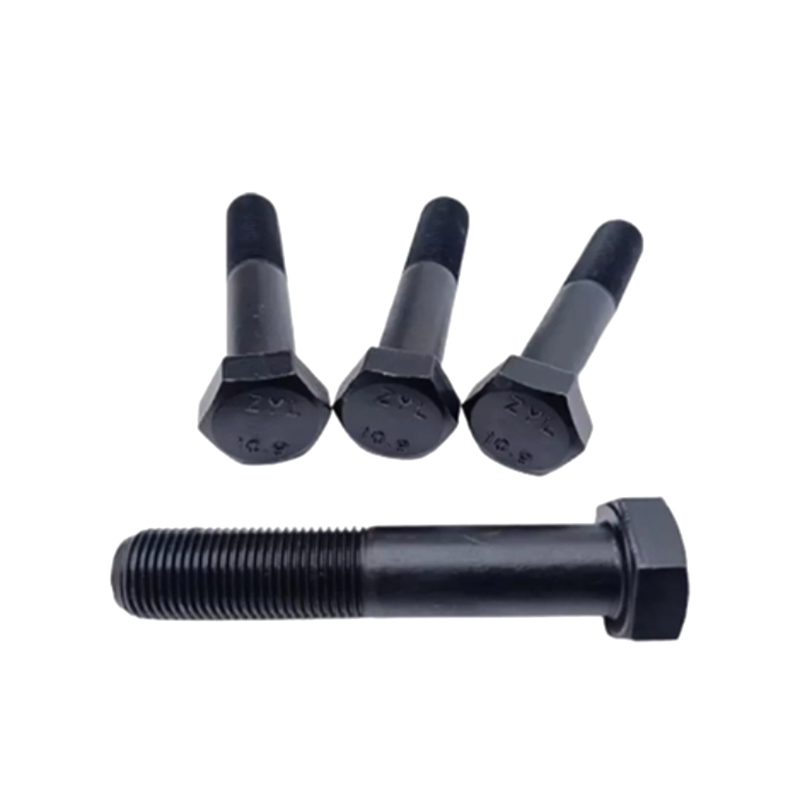
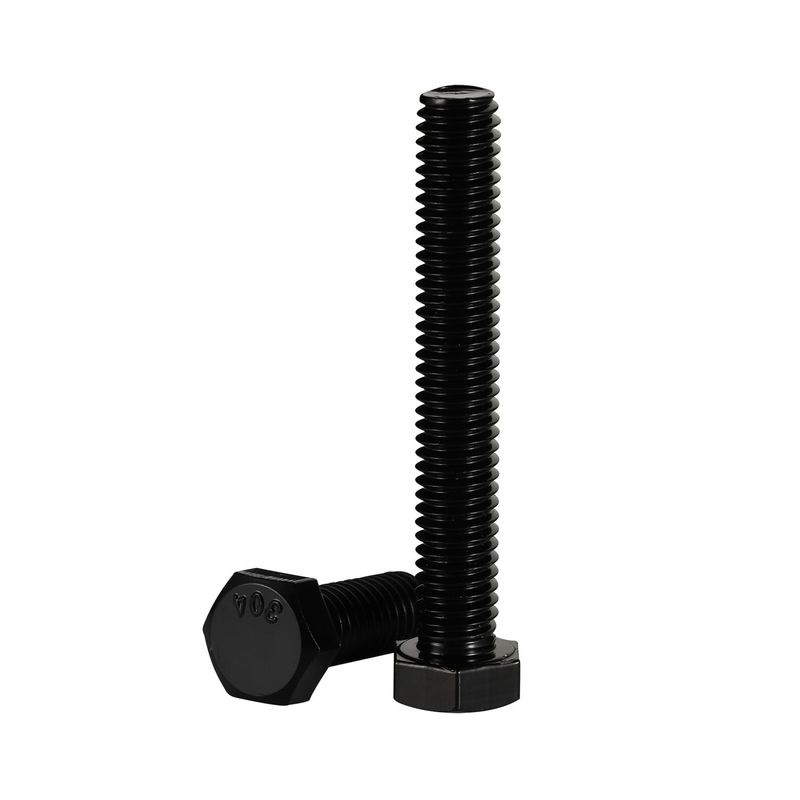
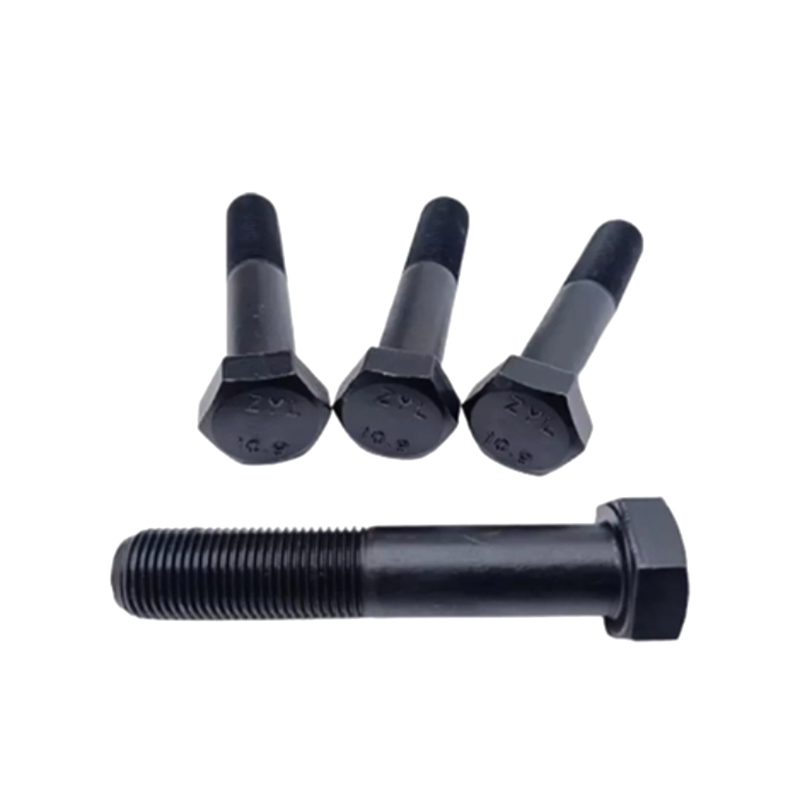
The markings stamped or embossed on the head of an external hex bolt are not branding — they are certifications of mechanical performance class and manufacturer identity that carry legal and engineering significance in quality-controlled supply chains. Misreading or ignoring these markings is one of the root causes of counterfeit fastener infiltration into structural assemblies, where visually identical bolts with different property class stamps may have tensile strengths differing by 30% or more.
ISO 898-1 Head Marking System Decoded
- Property class number (e.g., 8.8, 10.9, 12.9): The digit(s) before the decimal point, multiplied by 100, give the minimum tensile strength in MPa. The digit after the decimal point, multiplied by 10, gives the ratio of yield strength to tensile strength as a percentage. An 8.8 bolt therefore has minimum 800 MPa tensile strength and 80% yield ratio (640 MPa minimum yield). A 10.9 bolt has 1040 MPa tensile and 940 MPa yield — not simply "stronger than 8.8" but a fundamentally different material heat treatment condition.
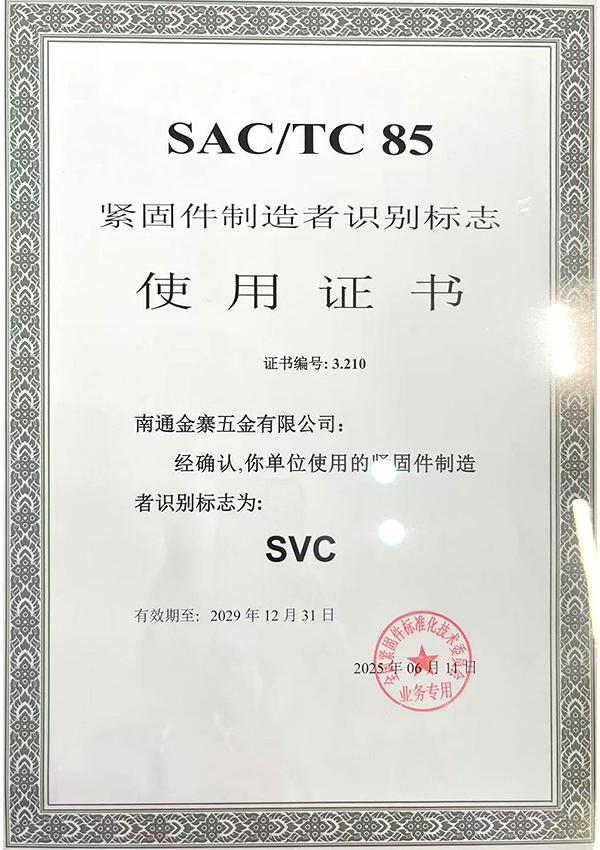
- Manufacturer identification mark: Required alongside the property class by ISO 898-1. This is typically a logo, code, or clock-position mark. Without a traceable manufacturer mark, the property class claim cannot be verified against production records — a gap that customs and quality auditors flag as a counterfeit indicator. Reputable suppliers including Shanghai Soverchannel Industrial Co., Ltd. maintain traceability from head marking back to heat treatment batch and material mill certificate.
- Left-hand thread indicator: Standard hex bolts carry right-hand threads and no chirality marking. A left-hand thread bolt is marked with an "LH" stamp or a groove on the flats. Substituting a right-hand bolt in a left-hand application — common in rotating machinery where the thread direction is intentional to prevent loosening — will cause the fastener to self-unscrew under load.
- Stainless steel grade marking: Stainless external hex bolts follow ISO 3506-1 and carry a different marking system: A2-70, A4-80, etc. The letter-number prefix indicates steel group (A2 = 304, A4 = 316) and the number indicates minimum tensile strength in units of 10 MPa. An A4-70 bolt therefore combines 316 alloy corrosion resistance with 700 MPa tensile strength. Mixing these with carbon steel grade markings is a common source of specification error in mixed-material assemblies.
Under-Head Bearing Surface Geometry and Its Effect on Clamp Load Consistency
The clamp force a bolted joint develops is determined by how completely the tightening torque is converted into bolt preload — and a surprisingly large share of that torque, typically 40–50%, is consumed by friction under the bolt head bearing face rather than in the thread. The geometry and condition of this bearing surface therefore directly governs clamp load consistency across a batch of identical bolts tightened to the same torque specification. Two external hex bolts with identical grade and dimensions but different bearing face flatness, surface finish, or washer face geometry can produce clamp load scatter of ±20% or more when torque-controlled to the same value.
Bearing Surface Variants in External Hex Bolt Standards
| Head Type |
Bearing Face |
Friction Characteristic |
Typical Use |
| Standard hex (ISO 4014/4017) |
Flat annular, no washer face |
Variable — surface finish dependent |
General structural, machinery |
| Hex with washer face |
Machined concentric washer boss |
More consistent — defined contact zone |
Precision assemblies, engine components |
| Flange hex bolt |
Integral serrated or plain flange |
Larger area — lower surface pressure |
Automotive body, soft substrates |
| Hex bolt with spherical face |
Convex radius bearing surface |
Self-aligning — compensates angularity |
Pipe flanges, misaligned joint faces |
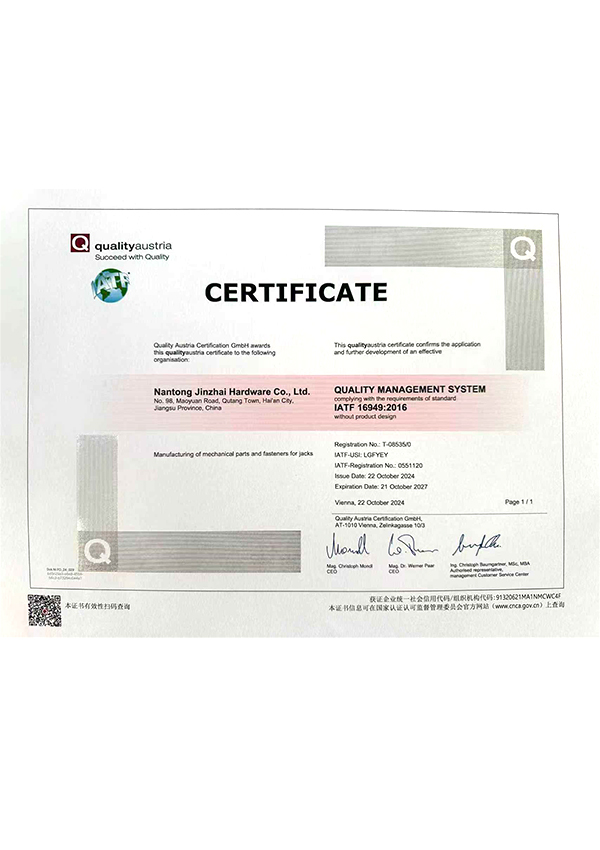
For torque-critical automotive assembly — cylinder head, wheel hub, and steering component connections — the washer face variant is strongly preferred because the machined contact zone provides a repeatable friction coefficient that allows torque-to-clamp-load calibration to hold within ±10% lot to lot. Shanghai Soverchannel Industrial Co., Ltd. produces both standard and washer-face external hex bolt configurations through its Nantong Jinzhai Hardware Co., Ltd. manufacturing plant, with bearing face flatness and surface finish measured and documented for customers whose tightening specifications require verified friction coefficients.
Grip Length Selection in External Hex Bolt Joints: Why Getting This Wrong Is Costly
Grip length — the unthreaded shank portion of a partially threaded hex bolt — is one of the most frequently misspecified dimensions in bolted joint design, and errors in grip length selection are responsible for a disproportionate share of joint failures in construction and machinery applications. The grip length must equal or slightly exceed the total thickness of all clamped members, including washers, so that the threaded portion of the bolt is entirely below the joint interface and the shank carries the shear load where it acts. If the grip length is too short, thread crosses the joint interface and carries shear through a stress-concentration zone that is not designed for transverse load.
- Too short a grip: Threads engage inside the joint material. Under shear load, the helical thread root acts as a stress concentrator and initiates fatigue cracking at a fraction of the load the smooth shank cross-section would sustain. In structural steel connections designed per EN 1993-1-8, this is explicitly prohibited — the standard requires the thread to clear the shear plane by at least 2 thread pitches on the nut side.
- Too long a grip: The shank extends beyond the joint material and into the thread engagement zone, leaving insufficient thread length for the nut. The minimum thread engagement for steel-on-steel connections is one bolt diameter; dropping below this by using too-long a grip shortens the effective engagement and increases the risk of nut thread stripping under tensile overload.
- The washer thickness trap: A common site error is specifying grip length against the nominal plate thickness and then adding washers in the field without adjusting bolt length. Adding two standard washers to an M20 connection adds approximately 6 mm of total thickness, which can shift thread engagement from compliant to marginal on a bolt selected to the exact nominal plate thickness.
- Fully threaded bolts in shear joints: ISO 4017 (fully threaded hex bolts) should not be used in joints where the bolt crosses a shear plane, for exactly the stress concentration reason above. They are appropriate only for tension joints, tapped-hole connections, and applications where the entire joint thickness is smaller than the standard thread length for that diameter-length combination.
Determining the correct grip length requires summing the thickness of every element the bolt passes through — primary plates, packing plates, washers, and gaskets — and selecting the next standard bolt length above that sum that still provides adequate thread engagement in the nut. Shanghai Soverchannel Industrial Co., Ltd. supplies external hex bolts in standard and custom lengths with fully documented grip length and thread length breakdowns, allowing customers to confirm compliance with their joint design requirements before placement rather than discovering errors during installation.
Corrosion Performance of External Hex Bolts in Marine and Chemical Environments: Beyond Basic Stainless
The assumption that "stainless steel" external hex bolts are corrosion-proof in aggressive environments is one of the most persistent and dangerous misconceptions in industrial fastener procurement. Austenitic stainless grades A2 (304) and A4 (316) provide excellent general corrosion resistance, but both are susceptible to specific corrosion mechanisms — pitting, crevice corrosion, and stress corrosion cracking — that can cause rapid and complete failure in conditions that these grades were not designed to handle. Selecting the right material requires matching the alloy's known failure thresholds to the actual chemical environment, not simply specifying "stainless."
Corrosion Failure Modes by Environment and Alloy
| Environment |
A2 (304) Risk |
A4 (316) Risk |
Recommended Alternative |
| Seawater immersion |
High — rapid pitting |
Medium — crevice corrosion at threads |
Duplex 2205 or Super Duplex 2507 |
| Chloride atmosphere (>200 ppm Cl⁻) |
High — pit initiation at 60°C+ |
Low-medium |
A4 or Duplex 2205 |
| High-temp bolted joints (>150°C under stress) |
Medium — SCC risk in chloride |
Medium — SCC threshold lowers at temp |
Alloy 825, Alloy 625 for severe cases |
| Dilute sulfuric acid (pH 3–5) |
High — uniform dissolution |
Medium |
904L or Alloy 20 |
| Coastal industrial (C4 ISO 9223) |
Medium |
Low — suitable with passivation |
A4 passivated per ASTM A967 |
Stress corrosion cracking (SCC) deserves specific attention for high-grade stainless external hex bolts in tensile-loaded joints above 150°C in the presence of chlorides. Unlike pitting, which is visible and progressive, SCC is a delayed fracture mechanism — the bolt can appear intact and hold load for weeks or months before suddenly fracturing at a stress well below its rated tensile strength. The combination of sustained tensile stress (from preload), a susceptible alloy (austenitic stainless above A2-70 or A4-70 property class), and chloride environment creates the conditions for SCC initiation. In these applications, Duplex 2205 stainless — with its ferritic-austenitic microstructure — provides roughly 10× better SCC resistance than A4-80 while maintaining adequate corrosion performance in chloride environments up to approximately 250 ppm Cl⁻ at operating temperature.
Torque Tightening Methods for External Hex Bolts: When to Use Which Approach
Tightening an external hex bolt to a specific torque value is the most common assembly method, but torque alone is a poor proxy for preload. Studies consistently show that the same tightening torque produces bolt preloads scattered across a ±25–30% range due to friction variability at the thread and under-head contact surfaces. This scatter is the root cause of many joint failures that appear — on paper — to have been assembled correctly. Understanding which tightening method to apply based on the joint's criticality and the available tooling determines whether the joint achieves its designed clamp force in production, not just in the engineering calculation.
Tightening Method Comparison for External Hex Bolt Joints
- Torque control (Nm-only): The simplest and most common method. Preload scatter ±25–30% due to friction variability. Appropriate for non-critical joints, general machinery, and construction connections where the joint is designed with sufficient safety margin to absorb this scatter. ISO 4016 and DIN 601 joints in building frameworks are typically torqued by this method.
- Torque-and-angle (torque-angle control): Applies a snug torque followed by a specified rotation angle, deliberately stretching the bolt into the plastic region in a controlled way. Preload scatter reduces to ±5–10% because the angle-controlled elongation is almost independent of friction once in the plastic zone. Standard for automotive cylinder head, connecting rod, and wheel hub bolts. Requires a torque-angle gun or wrench with angle measurement.
- Yield-controlled tightening: A servo-controlled nutrunner monitors the torque gradient in real time and stops when it detects the knee in the torque-angle curve that indicates yield point crossing. Achieves preload scatter of ±3–5%. Used in high-precision powertrain and safety-critical automotive assemblies. The bolt must not be reused — once yielded, the controlled curve reference is invalid for re-tightening.
- Direct tension indication (DTI washers): A compressible washer with protrusions under the bolt head collapses at a calibrated load, providing visual confirmation that minimum preload has been achieved regardless of friction. Specified in structural steel frameworks (AISC 360, BS EN 14399) for high-strength friction grip connections. The visual confirmation removes operator torque consistency as a variable entirely.
- Hydraulic tensioning: Applies axial tension directly to the bolt shank using a hydraulic jack, then locks the nut at zero thread friction. Achieves preload accuracy of ±2–5% and is the standard method for large-diameter bolts (M36 and above) in pressure vessel flanges, wind turbine tower joints, and bridge cable anchor assemblies where wrench access and human torque application are impractical.
Shanghai Soverchannel Industrial Co., Ltd. supplies external hex bolts with documented tightening parameter recommendations matched to the property class and application — including torque values, angle specifications for torque-angle assemblies, and friction coefficient assumptions — giving assembly engineering teams the data needed to calibrate tooling correctly rather than relying on generic torque tables that may not match the actual friction condition of the bolt surface treatment specified.


 中文简体
中文简体 Português
 Español
 Deutsch
 русский
 عربى
عربى